
Pre-Ramble.
Good morning! In Western Scotland, on the Peninsular of Kintrye - the same Kintyre as Paul McCartney's "Mull of Kintyre", which I have also visited on this trip! - is the town of 'Ceann Loch Chille Chiarain'. In English: Campbeltown.Campbeltown has it's roots as a fishing village, however in the early-to-mid 1800s Whisky arrived to the town. It's real claim to fame. At the town's peak, there was over 100 distilleries! Now, granted, only 28 of these were legal, which is where many knowledge sources such as Wikipedia get their number from -- but locals say that there were profoundly more than that.
From Wikipedia:
Campbeltown is one of five areas in Scotland categorised as a distinct malt whisky producing region, and is home to the Campbeltown single malts. At one point it had over 30 distilleries and proclaimed itself "the whisky capital of the world".
Today, only three working distilleries remain, Glen Scotia, Glengyle, and Springbank. The latter of which is the only whisky distillery in Scotland that does everything, and it's the one that I visisted earlier today.
Springbank Distillery, Whisky, and a mighty tradition still in operation.
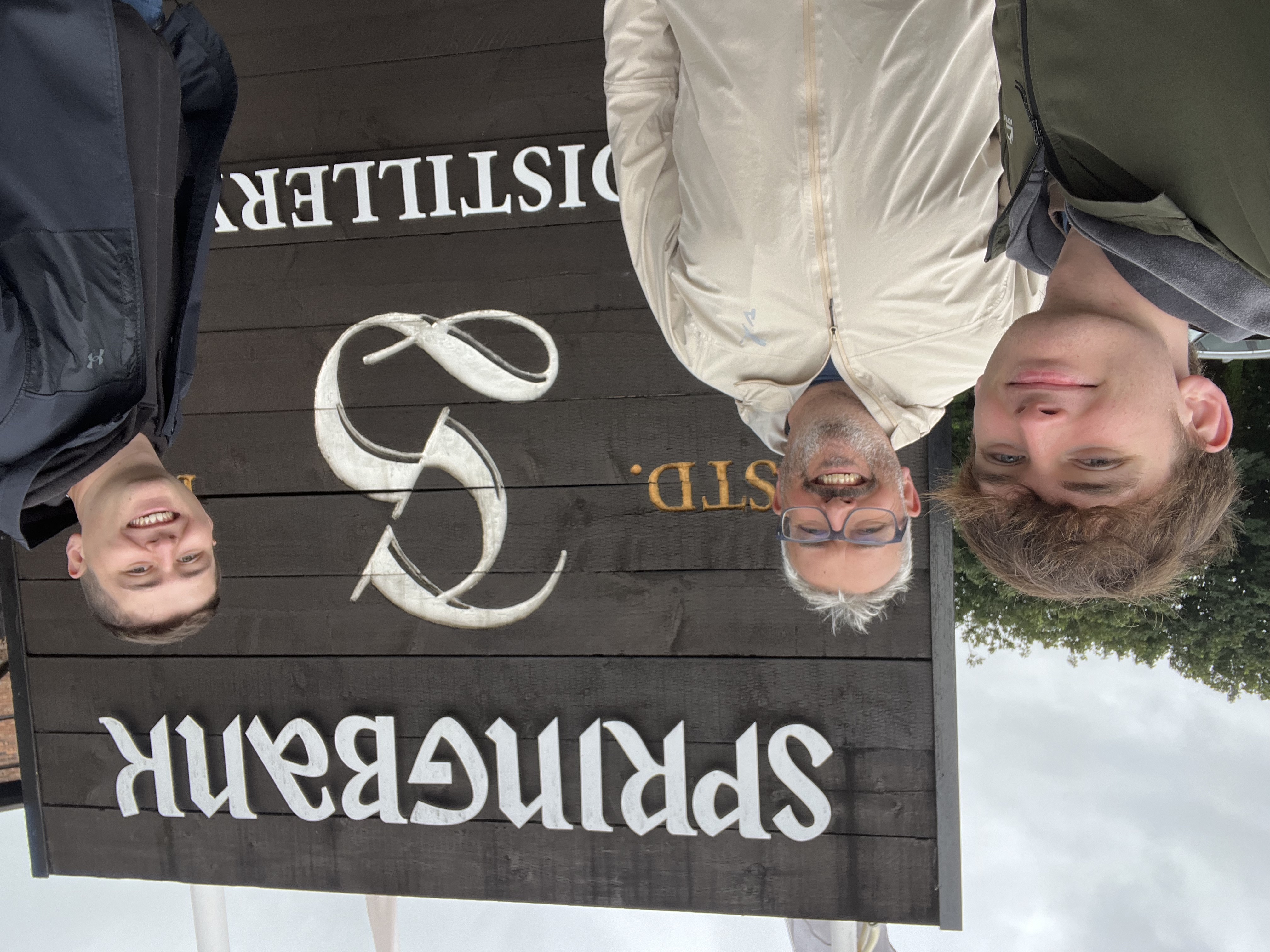
The tour actually had us started in the shop. The email had required that we arrive '15 to 30 minutes early', so we did.. I dont think we needed to. Despite obviously Whisky, which I am sure we will get to later on, there were selling lots of wood products made out of old Whisky barrels!
Bottle openers, coasters, fridge magnets, keychains, bookmarks, they even had a cheese slicing set. Anything that they could feasibly make out of old aged wood, it seemed they were ready to sell. To the right as you walk in was four sample stations of different whiskys. For free, anybody could try and sample some of their expressions, which i think is insanely kind and something you dont see increadibly often today.
Tricking barley into thinking it's spring.
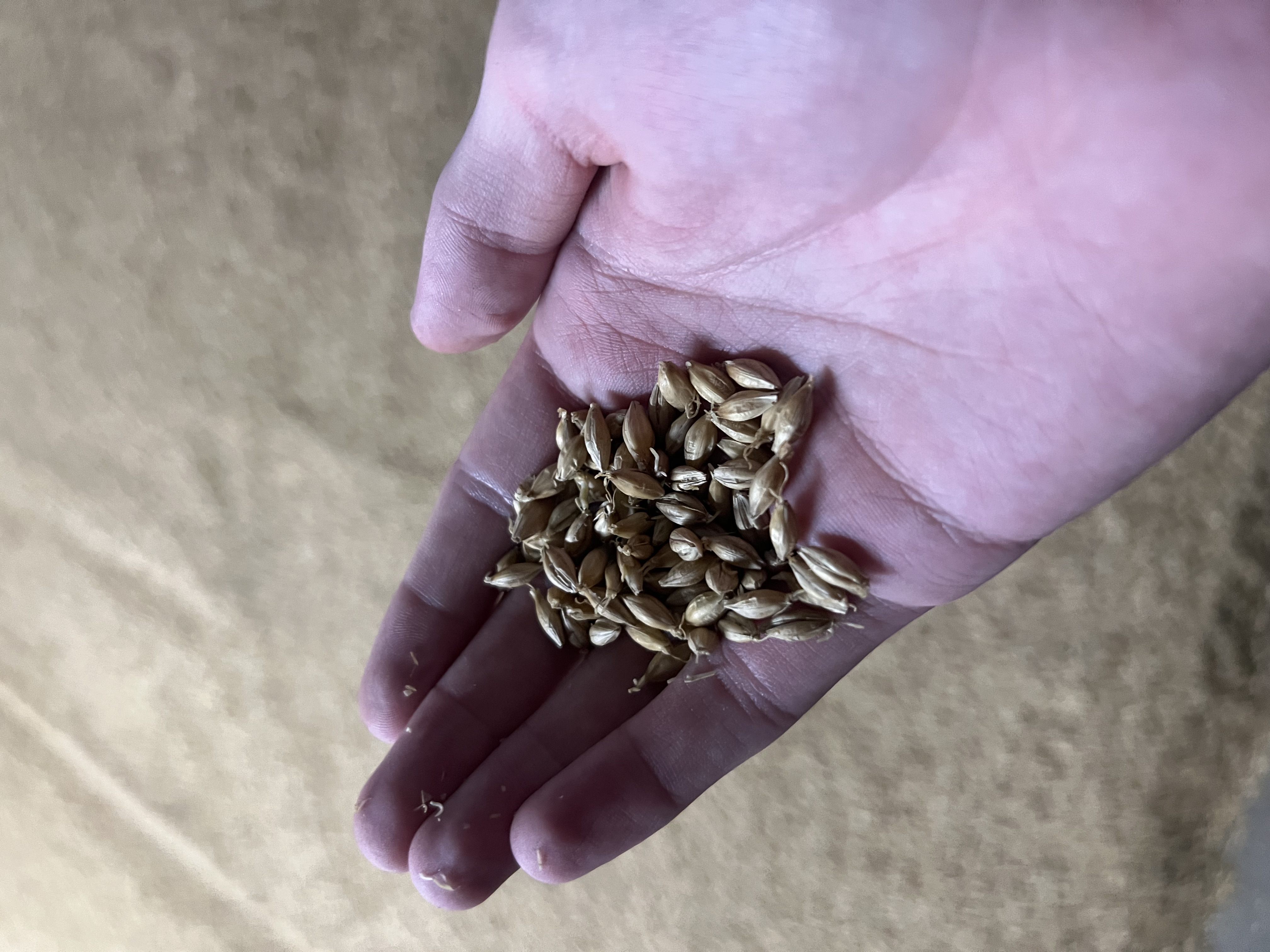
The tour guide first took us outside to the floor where they malt the barley. It's difficult to get a sense of scale over a picture, but this entire warehouse floor was covered with tiny little barley beads. It was only around 4 to 6 inches tall, as this depth allowed for all of the barley to remain at the same temperature.
Before any of it reaches the floor, the barley spends a couple of days in the steep soaked in cold water, drained, left to breathe, then soaked again. This repeats until it's gone from bone dry to about 45% water. This water allows tiny rootlets to start pushing out, meaning the barly as started to chit.
In the same room they had a manual turner machine that puts the barley at the bottom at the top, and vise versa. Purely for temperature management.
Cool!
What peat is actually for.
After that came the peat. I had absolutely no idea was peat did in Whisky, not a clue. Sometimes labels talk about the 'peat content'?? Yeah. No idea. Well:
Peat, the soiley but hard amalgomation of decaying matter, is what gives smokey whiskeys their smokey taste! Most places use local peat, however due to the location of Campbeltown their peat contained bits of sand which would turn to glass in the whisky making process -- not really ideal. Today, they predominantly get their dry peat from Peterborough and their wet peat from Inverness.
Setting fire to a bog.
The peat and the barley meet in the kiln.
Underneath the drying floor is a furnace, and the furnace is where all of that peat ends up. The floor above it is perforated -- thousands of little holes -- so that the smoke and the hot air rise straight up through the grain sitting on top of it. This is me looking up at that floor from underneath.
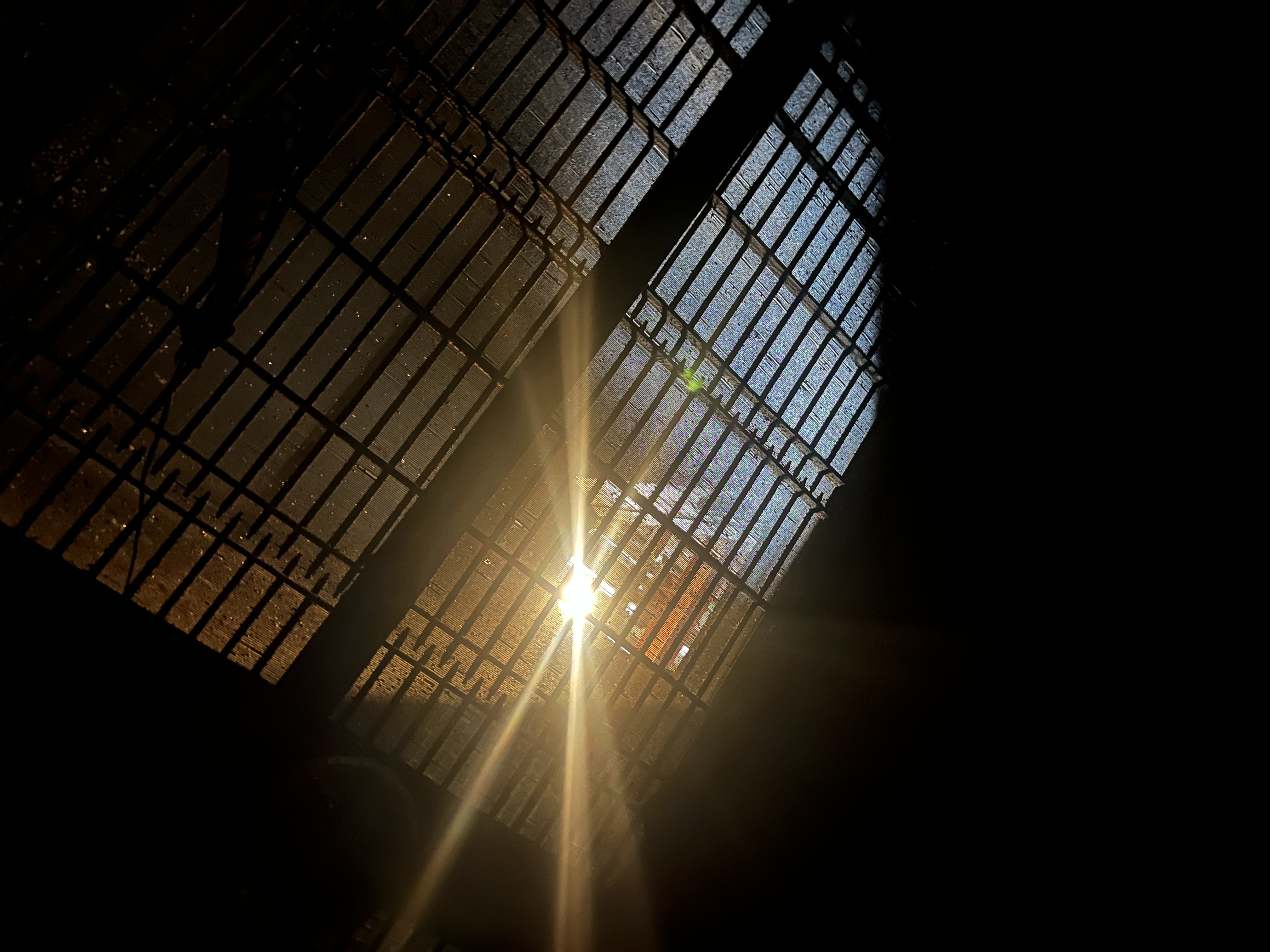
The kiln is doing two jobs at once. The obvious one is flavour -- smoke goes into grain, grain eventually becomes whisky, whisky tastes smoky. The less obvious one is that drying the barley out stops it growing. Remember that we spent two days tricking it into thinking it was spring; if you let it carry on believing that, the little plant keeps growing and eats all of the sugar we went to the effort of creating. So the kiln kills it at exactly the right moment, having got what we wanted out of it.
Slightly grim when you put it like that.
This is the bit where the three expressions they do here differentiate! Same barley. Same water. Same building, same people, same everything right up until this point. Longrow goes into the kiln with a long, heavy peat burn and comes out properly smoky. Springbank gets a short one and comes out lightly smoky. Hazelburn gets no peat at all, just hot air.
Three completely different whiskies, separated by nothing more than how long somebody keeps a fire lit.
Ten bins and a bit of slate.
Once the barley has malted, it's brought on old-school conveyor belts to get in malt hoppers. Each one of these 10 malt bins can hold 20 tonnes of barley. It takes 2 months to fill them, followed by a 2 month resting period.
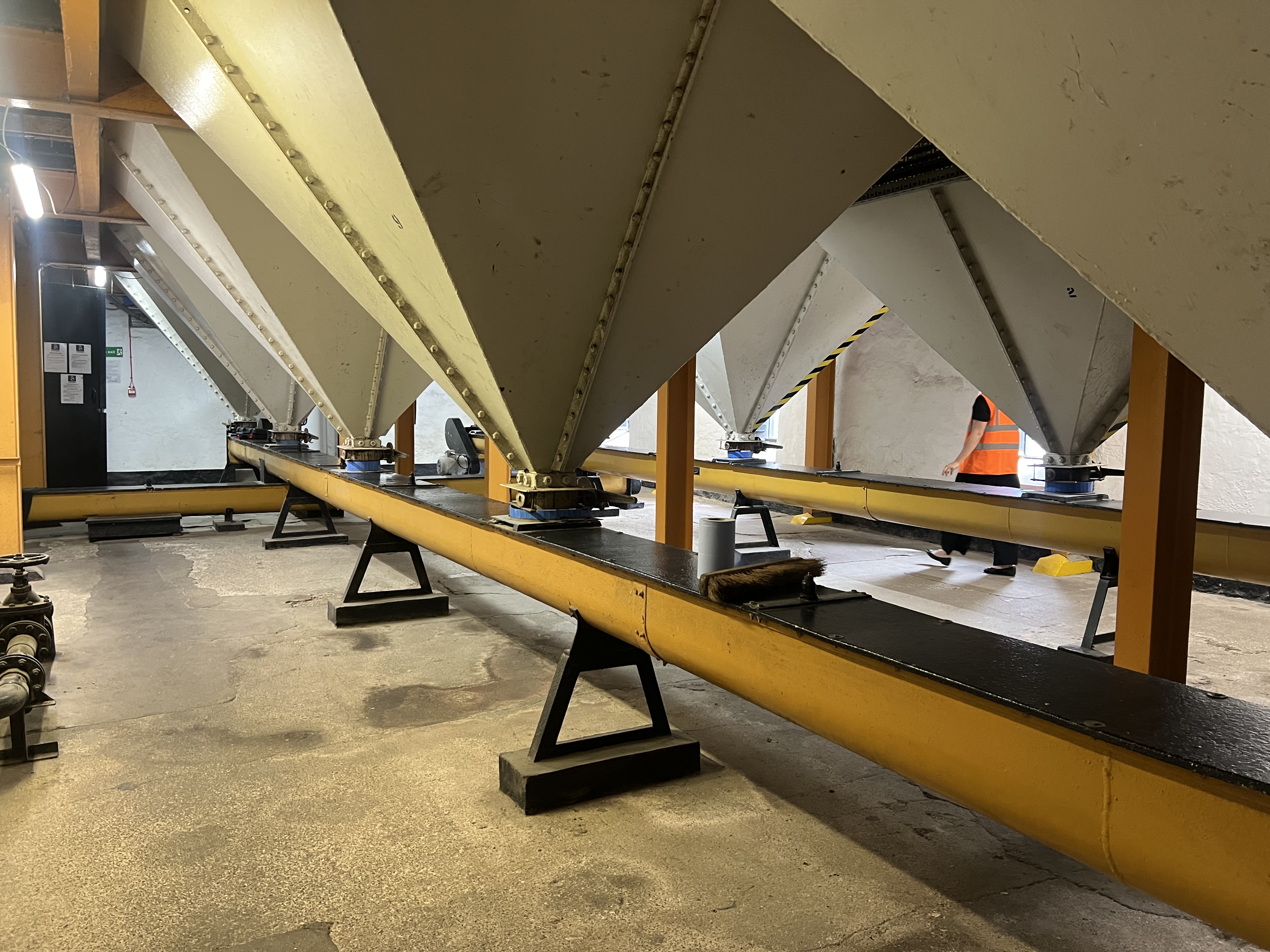
And i want to show you how they keep track of which bin is which:
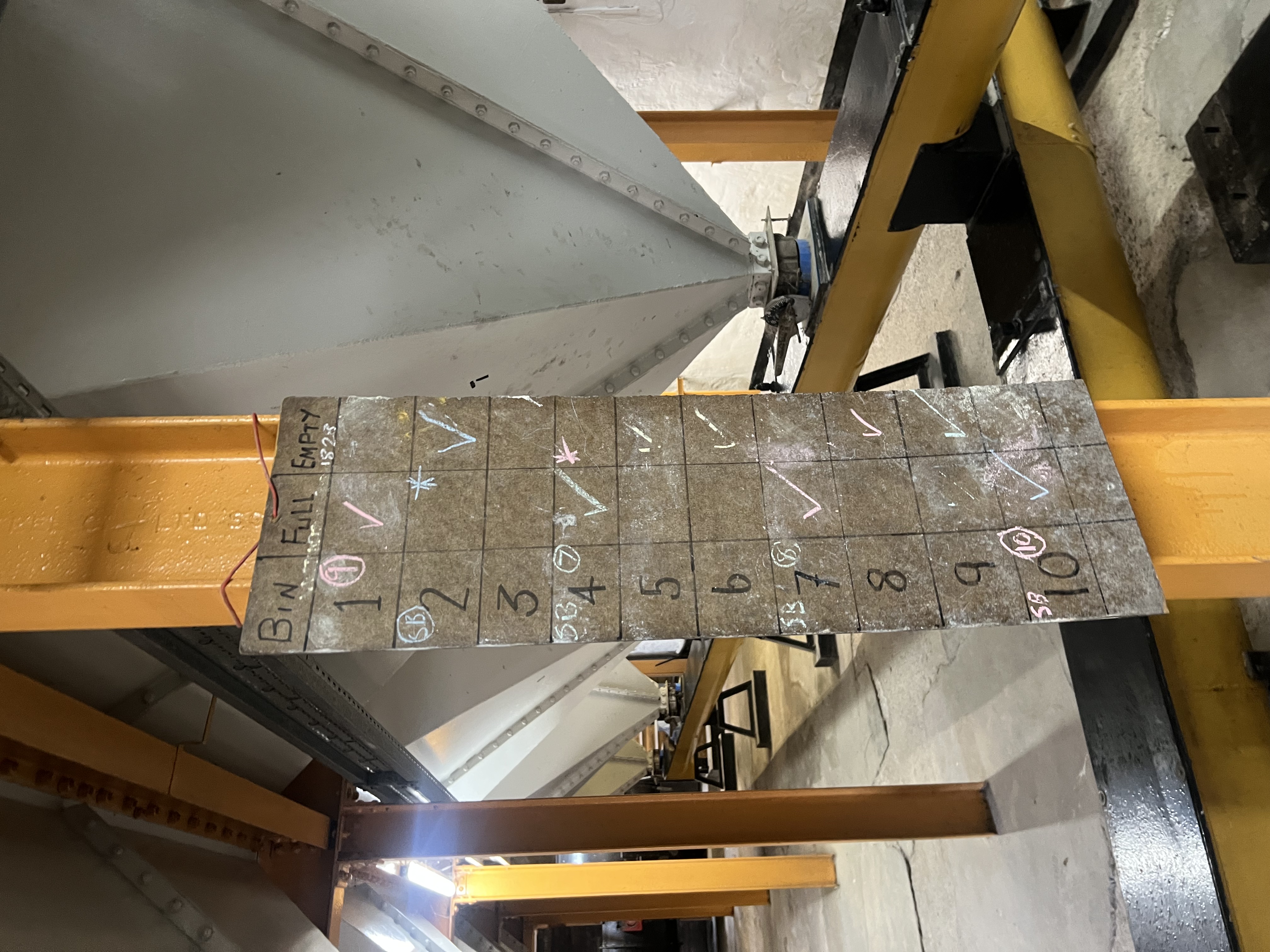
That's it. That's the inventory system! Two hundred tonnes of malted barley managed with a bit of slate and a stick of chalk. There really is something lovely about a place that could obviously afford a spreadsheet and yet has decided it doesn't want one.
The mill that killed its own manufacturer.
Next the malt gets crushed, which turns it into something called grist. That's all grist means -- crushed malt. You crack the grain open so that water can get at the starch inside.
The machine that does the crushing is a Porteous, and it dates back to the 1940s. This is where our guide told us my favourite fact of the entire tour:
Porteous mills were built so well that they never wore out. Nobody ever needed to replace one. Nobody ever needed to buy a second. So Porteous, having made a perfect product, had absolutely no repeat business, and went bust. Every distillery in Scotland is still happily running the mill it bought eighty years ago from a company that no longer exists.
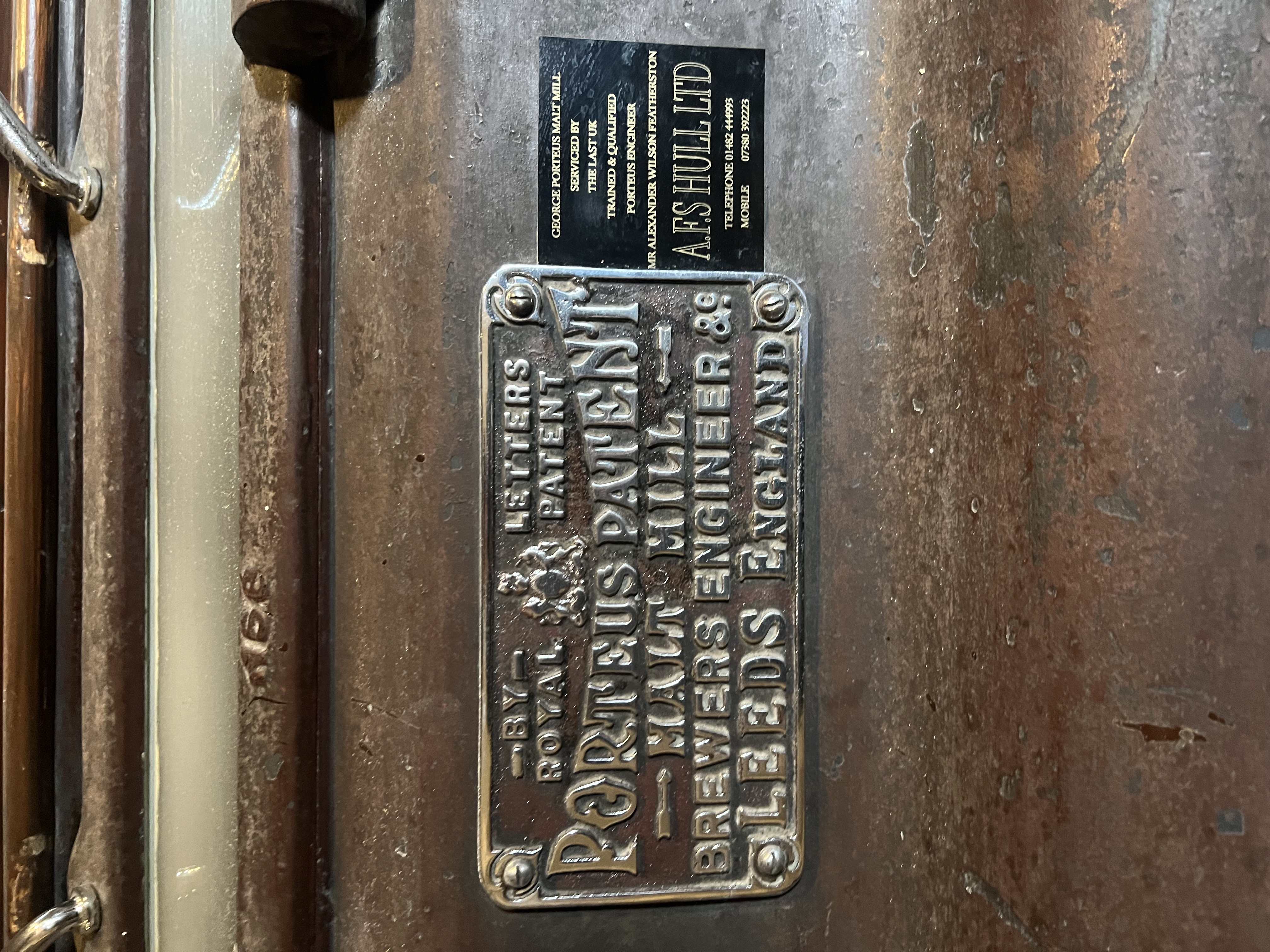
Look at the little black plate bolted on beside the big brass one. It names the last UK trained and qualified Porteous engineer -- a Mr Alexander Wilson Featherston, of A. F. S. Hull Ltd -- and gives his office number and his mobile.
A working distillery has one man's mobile number screwed to the side of its mill because he is the only person left who knows how to fix it. I love it here.
The mill has one job, an average batch is 3.4 tonnes, and the grist coming out of it should be 20% husks, 70% middles, 10% flour.
Which is meaningless until you know what happens next, so:
- husks are the shells
- middles are the coarse chunky bits from the middle of the grain
- flour is the fine powder
In the next stage the crushed malt sits in a big tank and hot water gets drained down through it. The husks form a natural filter bed that lets the liquid pass through. Too much flour and the whole lot turns to wallpaper paste and clogs solid, though too much husk and the water rushes straight through without picking anything up. 20/70/10, every time, from a machine older than most of the people looking at it.
Sugar water.
The tank in question is the mash tun, and Springbank's is a big open-topped cast iron thing painted post-box red. Almost everywhere else has moved to sealed stainless steel with a lid on it. This one you can walk up to and look into:
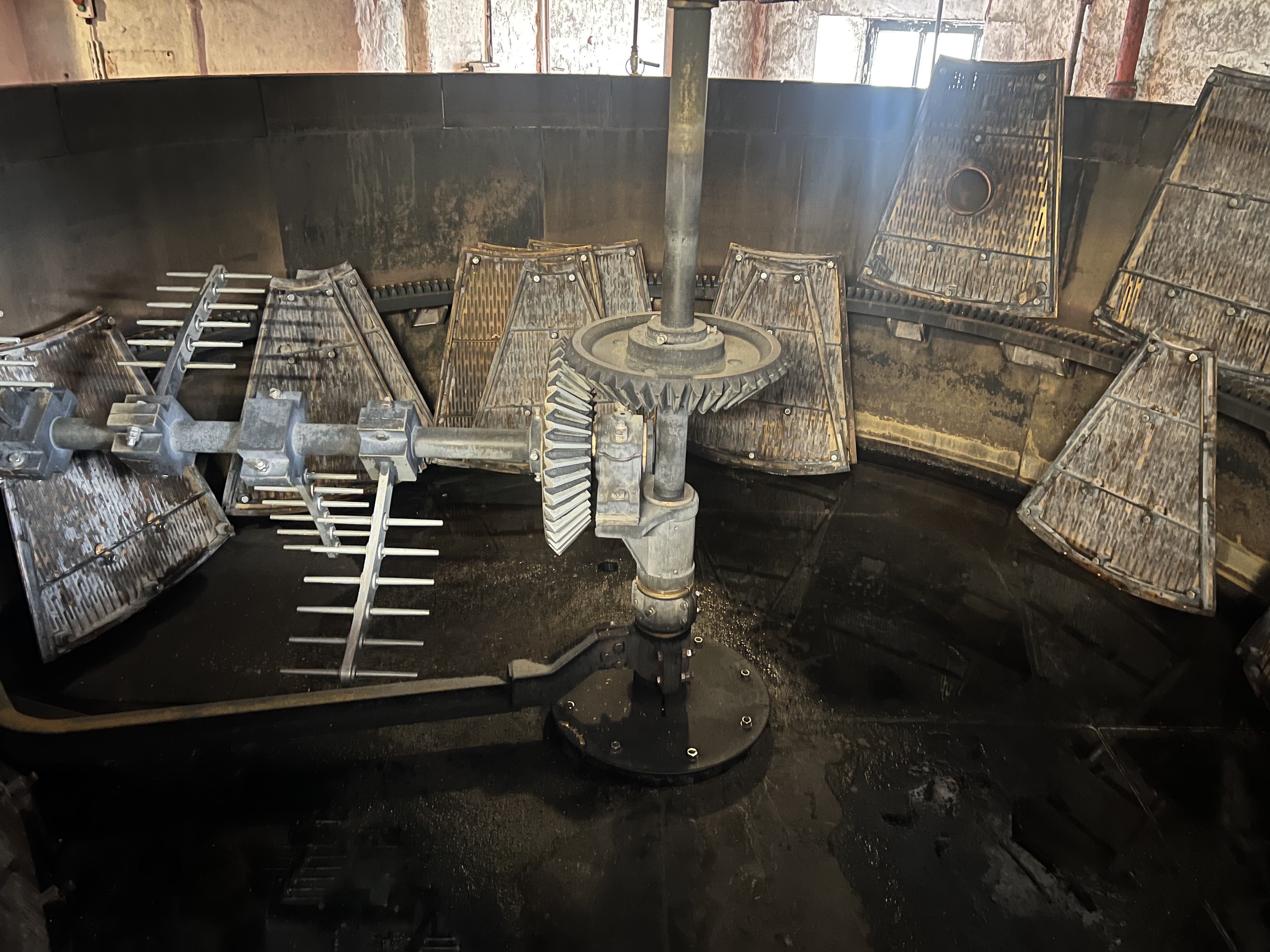
Those rotating arms with the teeth on them are the rakes, and they stir the mash around. The perforated plates on the floor are what the liquid drains out through.
The sweet liquid you drain off is called wort, pronounced "wert". It's only sugar water, just loads and loads and loads of it.
They put four waters through it, and the numbers are on a sign on the side:
| Volume | Temperature | |
|---|---|---|
| 1st water | 17,000 L | 63.5°C |
| 2nd water | 6,000 L | 72°C |
| 3rd water | 15,000 L | 82°C |
| 4th water | 6,000 L | 82°C |
The whole cycle takes about ten hours.
The temperatures going up like that isn't arbitrary. The first and coolest water is the one doing the actual work, because the enzymes turning starch into sugar are alive at 63.5°C and would be killed stone dead by anything much hotter. The later, hotter waters are just rinsing out whatever sugar is left. And because the third and fourth come out weak, they get kept and used as the first water of the next mash instead of being thrown away.
The soggy grain left at the bottom is called draff, and it goes off to local farms as cattle feed. Genuinely nothing is wasted in this building.
Beer, basically.
Now we add yeast, and once you add yeast to sugar water you are making beer. That is not a joke or a simplification -- what comes out of this stage is a flat, unhopped, slightly sour beer at around 6%, and if you drank a pint of it you'd know exactly what it was.
It ferments in washbacks, which is the industry's word for "big tub". Springbank has six of them, and they're made of wood:
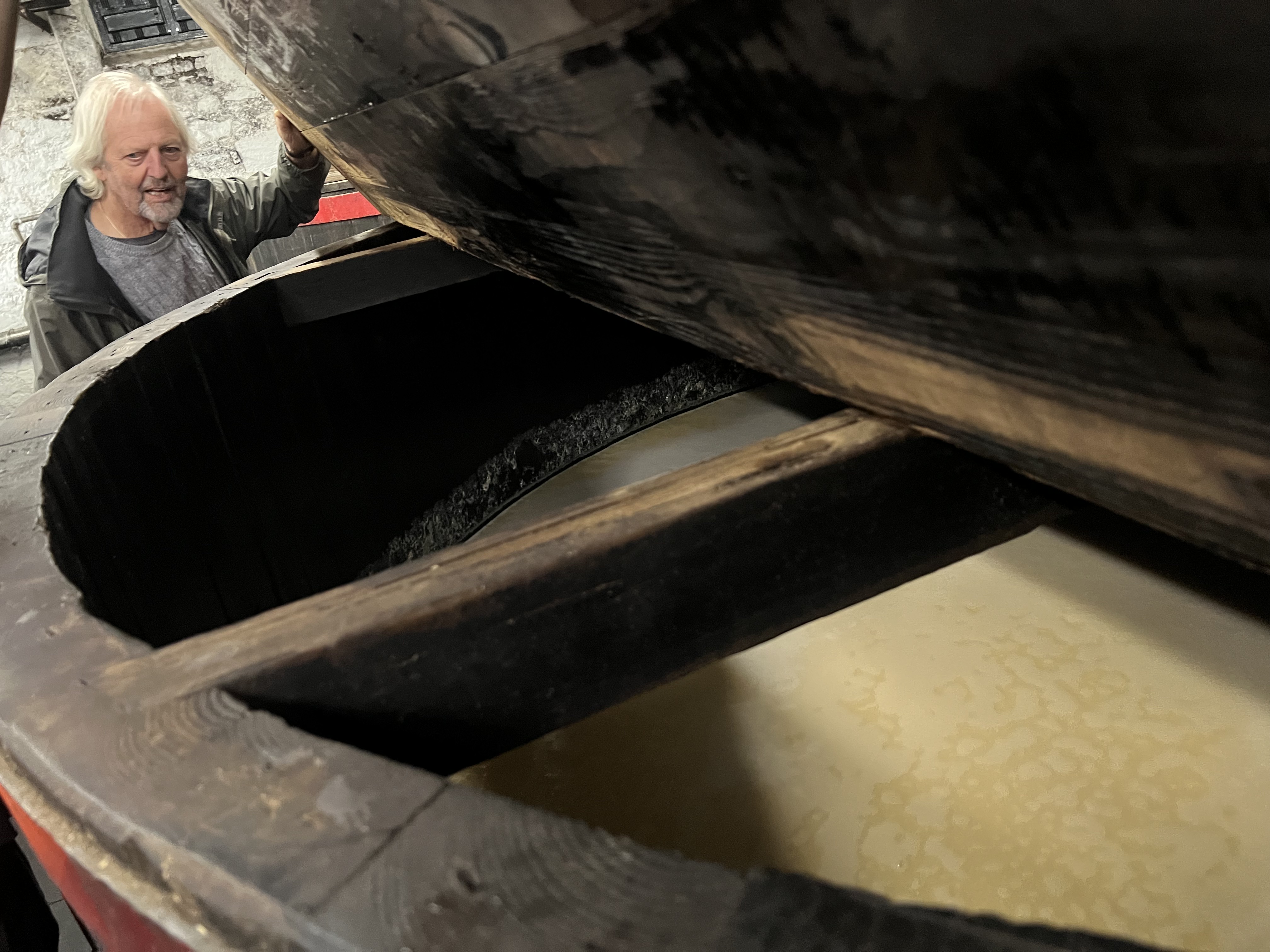
Twenty one thousand litres of wort and 75kg of yeast go into each one, and it sits there for a minimum of 72 hours and up to 110.
Both of those details are deliberately awkward choices. Wood is porous and impossible to properly sterilise, so bacteria live permanently in the timber. Dont think of it as a hygiene failure, it's a flavour source. And 110 hours is an enormously long fermentation; most distilleries run about 48. Once the yeast has finished its work, those resident bacteria keep going and produce all sorts of fruity, funky, complicated flavours.
Steel tubs and short ferments would be cleaner, faster, cheaper, and would make a duller whisky.
The still house.
Distillation sounds complicated and isn't. Alcohol boils at a lower temperature than water. So you heat up your beer, catch the vapour coming off it, cool it back down into a liquid, and what you've caught is stronger than what you started with. Do it again, it gets stronger again.
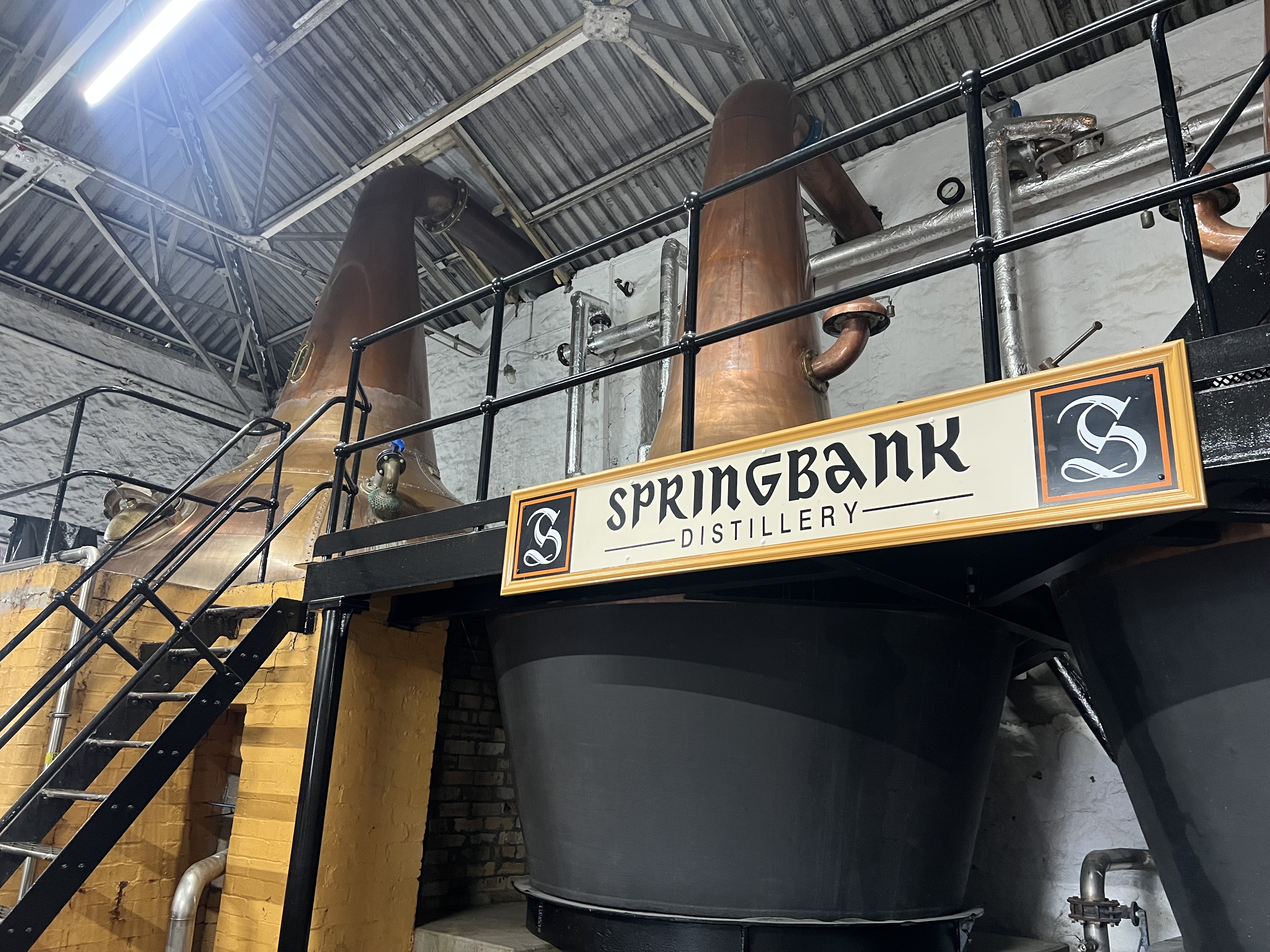
Springbank's wash still is direct fired, meaning there is an actual oil flame burning underneath the copper. Practically nobody does this any more because it's fiddly and it scorches the wash slightly -- and the scorching is precisely the reason they keep doing it.
There are some words to get through here, but they're all straightforward:
- low wines -- the weak spirit off the first distillation, about 20-25%
- foreshots -- the harsh, volatile stuff at the very start of a run
- feints -- the weak, oily stuff at the very end of a run
- middle cut -- the good bit in between, and the only part that becomes whisky
The foreshots and the feints don't get binned, they get tipped back into the next run. And the decision about exactly where to stop taking the foreshots and start taking the middle cut is made live, by hand, by the person standing there.
Then there's the diagrams on the wall, which explain Springbank's whole strange setup better than i can:
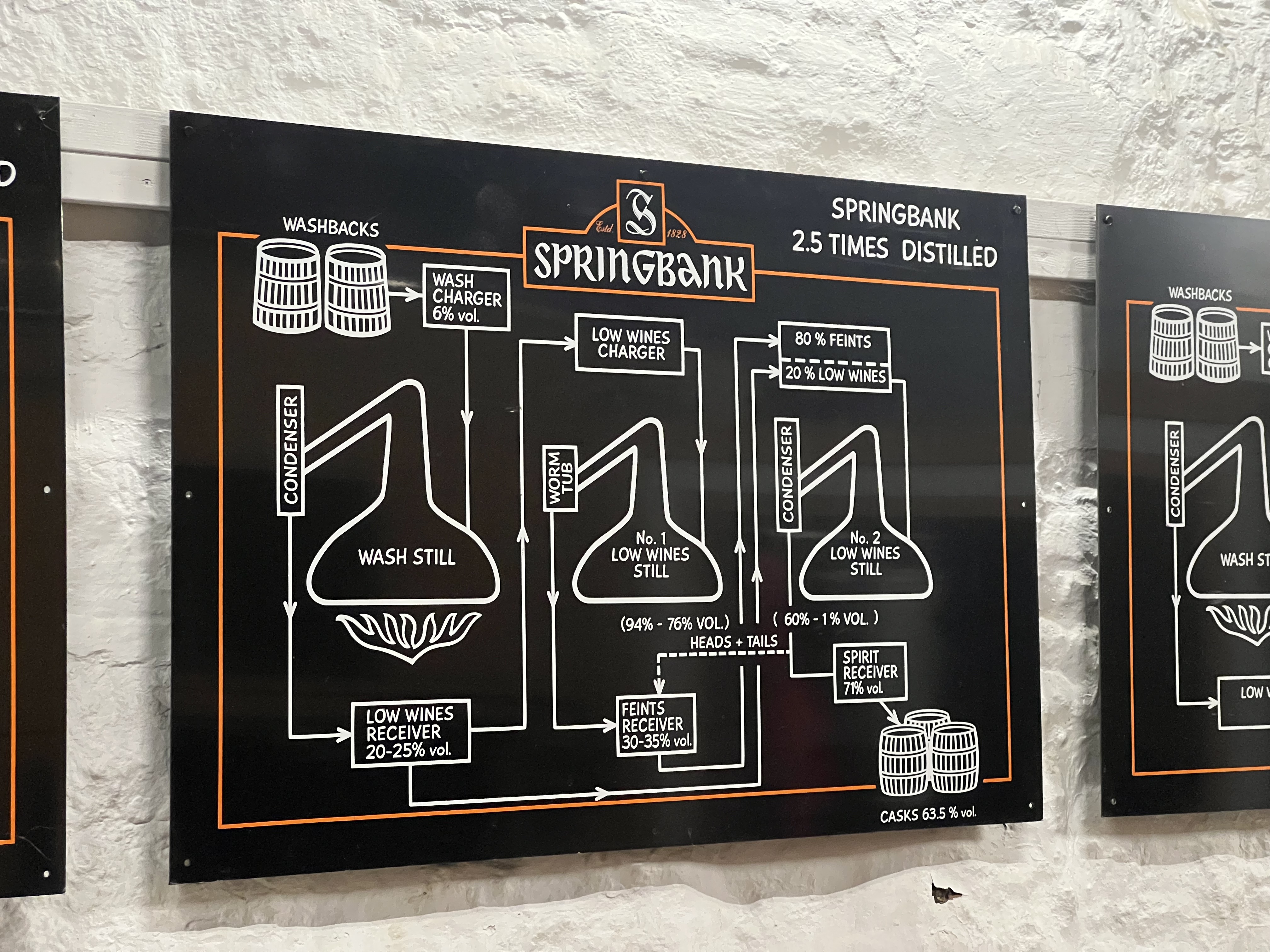
Longrow is distilled twice, which is normal. Hazelburn is distilled three times, which is actually the traditional irish way to do it! That's why irish whiskeys tend to be more floral or fruity.
Springbank is neither traditionally scottish nor irish, as it's distilled two and a half times, which is nonsense, and which nobody else in Scotland does. It goes through the wash still, then the first low wines still, and then only part of it goes through the second one -- the diagram breaks it down as 80% feints and 20% low wines. That partial third pass is the half.
The locked box.
This is the spirit safe, and it might be my favourite object in the whole distillery:
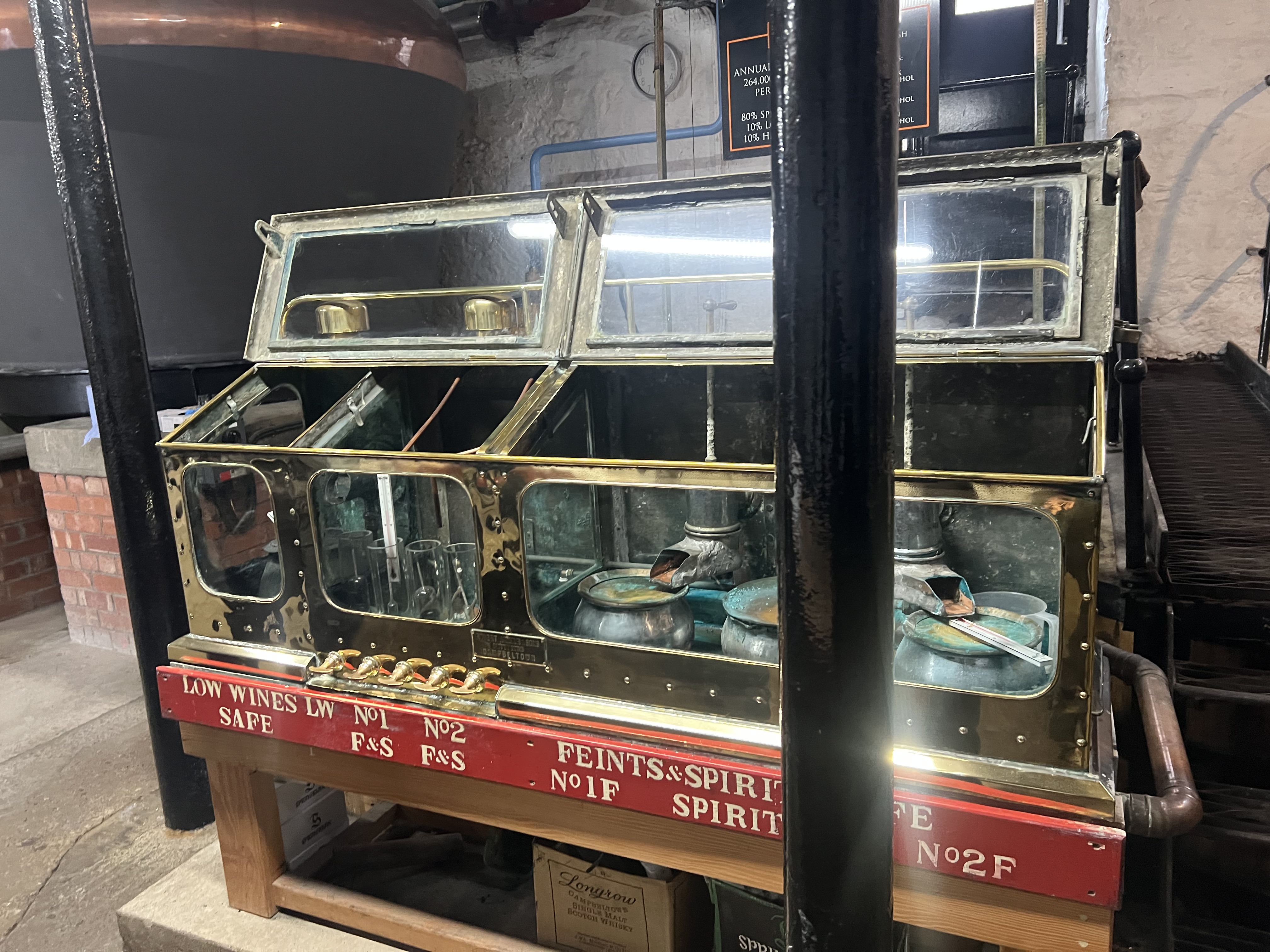
Brass and glass, padlocked shut. Historically, the only key was held by the Customs and Excise officer.
The reason is tax. Everything flowing through that box is untaxed alcohol, so the man actually making the whisky was not permitted to touch it. He could look at it, and he could test it with hydrometers through the sealed case, and that was it. Hence the glass -- the entire object exists so that a distiller can do his job while being physically prevented from getting at the product.
There's a desk right next to it with the handwritten record books on it, why use a computer when a book does the job.
There's also a sign nearby with the year's numbers on. 264,000 litres a year, of which 80% is Springbank, 10% Longrow and 10% Hazelburn. And it refers to what's coming off the still as plain British spirit, because legally that is what it is. It cannot be called whisky until it has sat in an oak cask in Scotland for three years.
Into the barrel.
Every cask gets filled at 63.5% alcohol, and they fill about sixty a week.
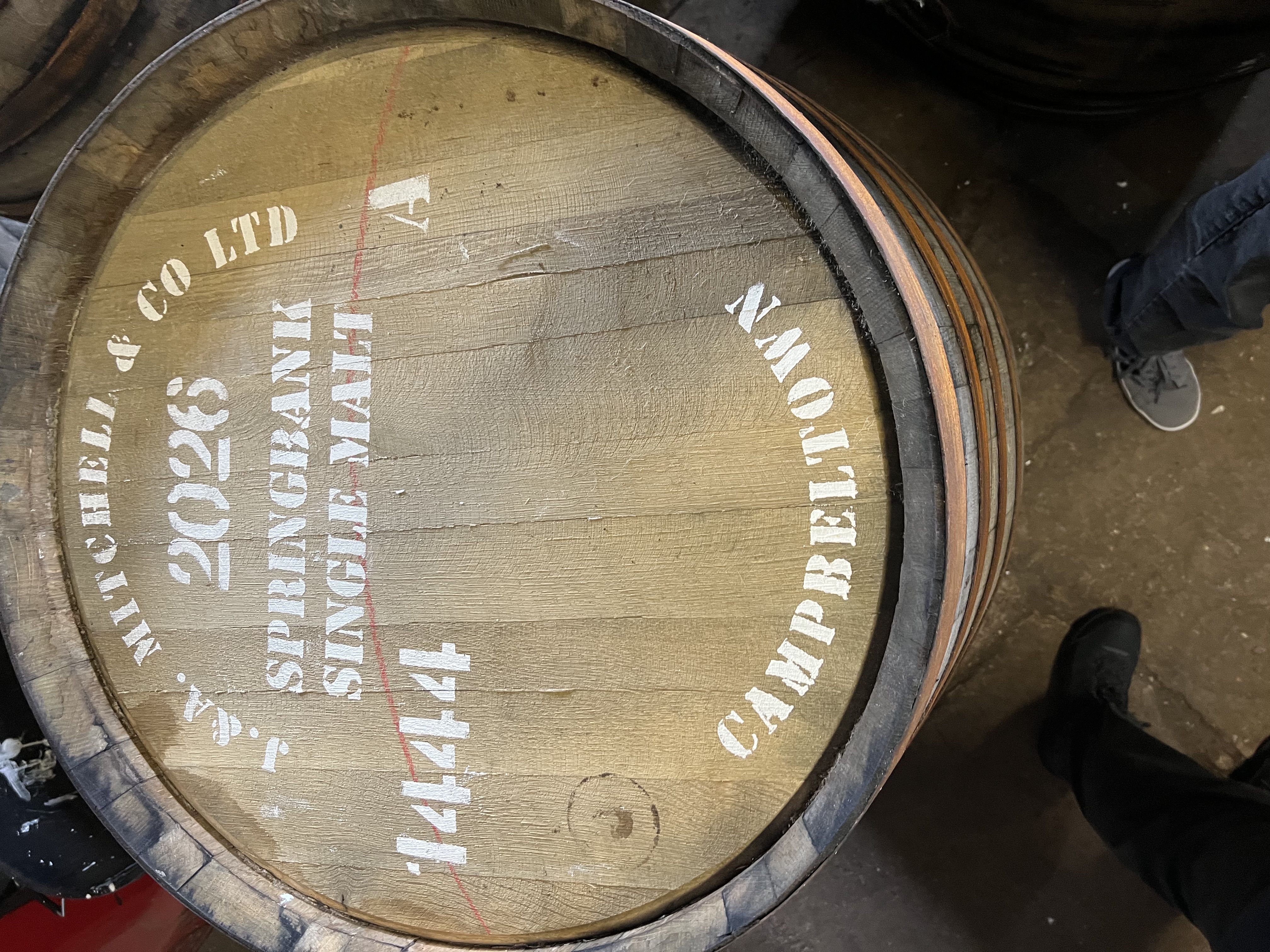
J & A Mitchell & Co Ltd -- the family who have owned the place since 1837 -- 2026, Springbank Single Malt, Campbeltown, cask number 1444. That means its the 1444th barrell made this year! The 'A' means that this is the first time the barrel has ever been used, as they can only be used twice. The wood of 'B' barrels still do the job of flavouring well enough, but a 'C' barrel (having now been used twice) is useless for whisky production. They're predominantly used as storage barrels or flowerbeds.
Where it sleeps.
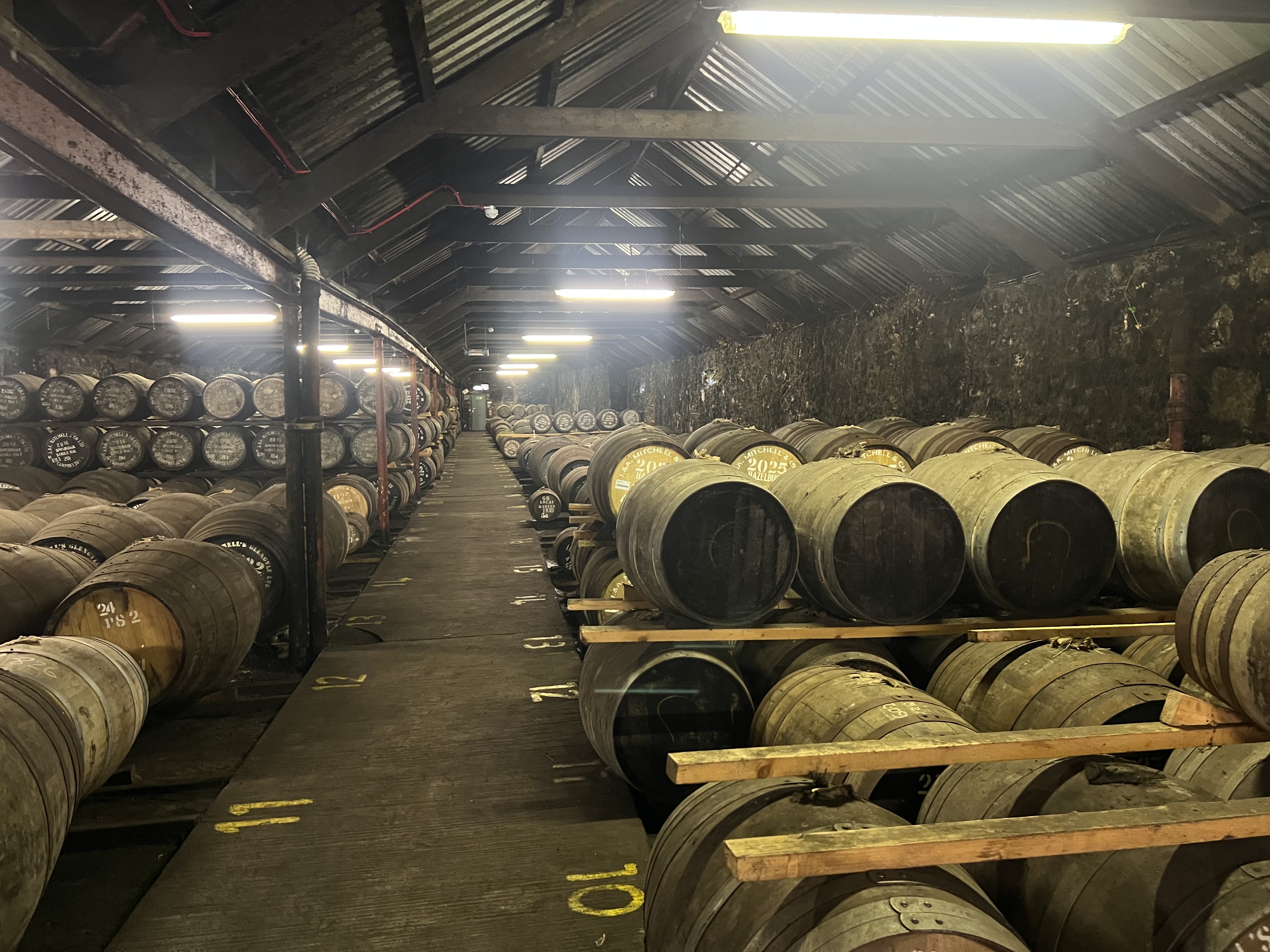
These are dunnage warehouses, which is the old way of doing it. Earth floors, thick stone walls, and casks stacked only three high on wooden rails. Cold, damp, and very stable in temperature. The modern version is a racked warehouse -- steel, twelve casks high, dry. Dunnage is worse in every single commercial respect and better for the whisky, which is a sentence you could apply to this entire distillery.
About 2% of every cask evaporates each year. That's the angel's share, and it's why a warehouse smells the way it does.
Our guide described the relationship between the spirit and the wood as a marriage, a honeymoon, and eventually a divorce. The marriage is the day it goes in the cask. The honeymoon is the years where the wood is giving it colour and vanilla and spice and the whisky is getting better every single year. The divorce is when the wood has given everything it had and starts taking over instead -- the whisky goes dry and tannic and over-oaked.
The entire skill of the job is bottling it before the divorce.
The bit i can't show you
We did get into the bottling hall. I just can't show you any of it -- phones away, no photos, because unreleased bottlings sit in there and they'd rather one didn't turn up online before they've announced it. Entirely fair.
You'll have to take my word for it, then, which is annoying, because bottling is the part most people don't realise is unusual. Nearly every distillery in Scotland tankers its whisky off to an enormous central bottling plant somewhere in the Lowlands. Springbank does it here. It was actually a brand new hall, only opened a couple of months back.
That is what "the only distillery in Scotland that does everything" actually means. The barley is malted here, distilled here, matured here and bottled here, and none of it leaves the walls until it's in a bottle in a box.
Next door.
On the walk back we passed the sign for Glengyle, which is owned by the same family and makes a whisky called Kilkerran. The distillery and the whisky have different names because the Glengyle name was already spoken for elsewhere.
It was revived in 2004, and it's a decent part of the reason Campbeltown still counts as a whisky region at all. You need more than a couple of working distilleries to justify being a region, and for a while there it was touch and go.
And then: the whisky.
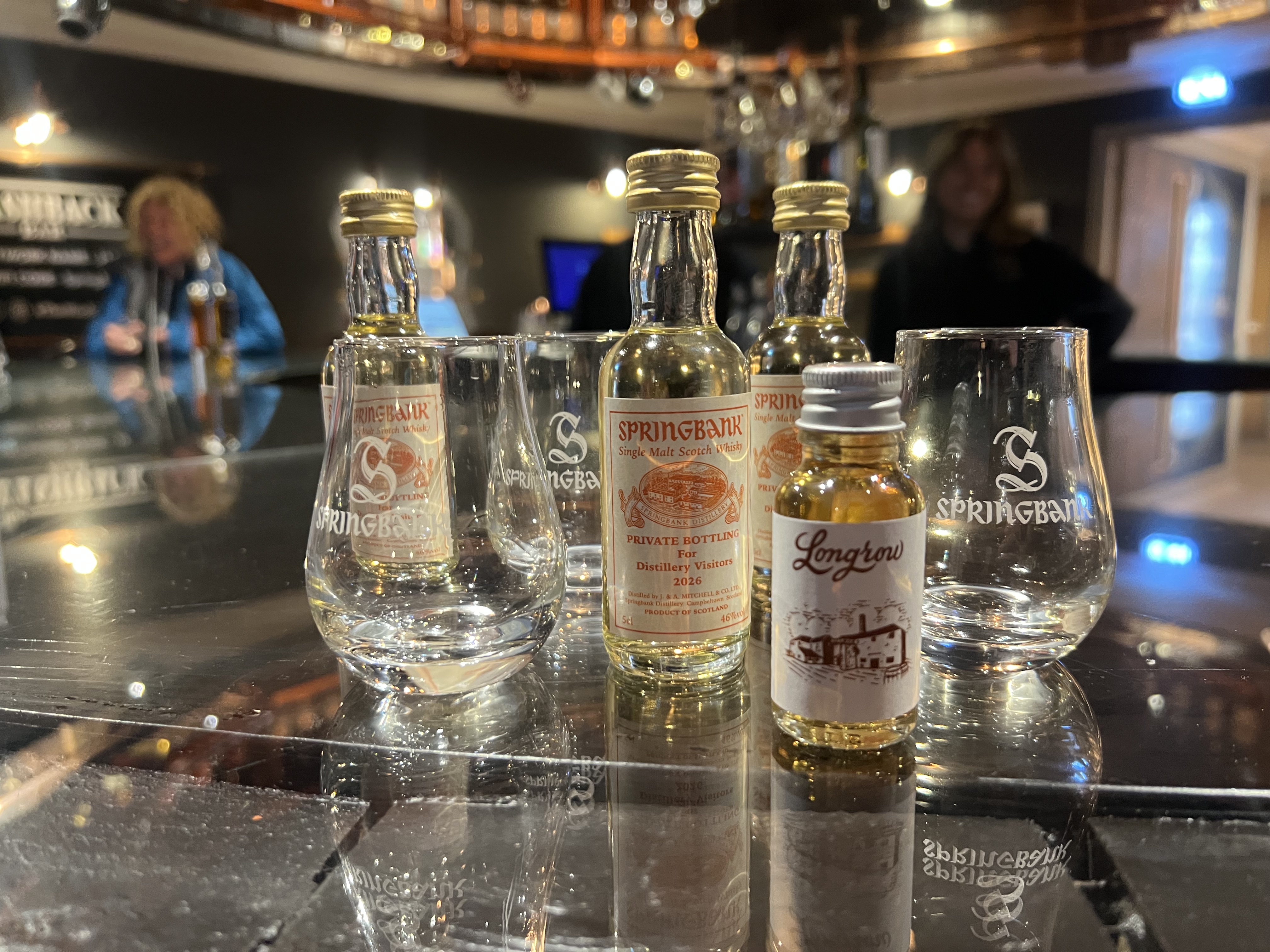
The tour finishes in the Washback Bar with a tasting, where you can choose between Springbank or Longrow. They give you a single for free to try, and a double in a bottle to go with it. They also have single bottles as driver's drams should you not be able to drink a shot of whisky at midday.
Having spent two hours watching cold water, a chalk slate, a bankrupt company's mill, a locked brass box and a damp stone shed all conspire to produce it, i will admit the Longrow tasted quite different to how it would have done that morning.
Didn't get a photo of the glasses full, like. Woe is me.
On the way out we spotted Cadenhead's, just down the road:
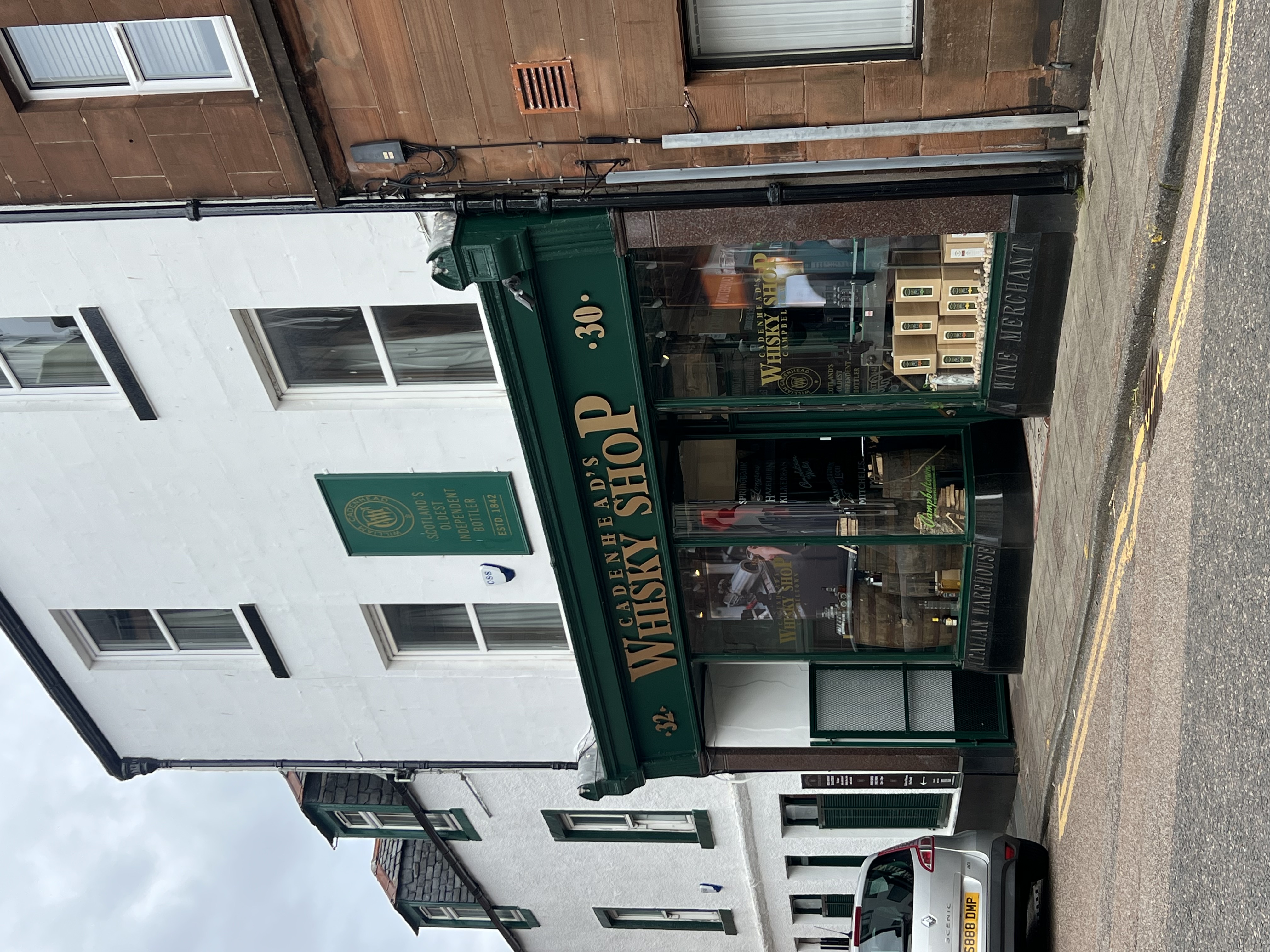
Cadenhead's is the oldest independent bottler in Scotland, founded in 1842, and - of course - owned by the same Mitchell family.
What got me about the whole thing wasn't any single piece of it. It's that at every point where there was an easier, faster, cheaper way of doing something, Springbank has looked at it and decided not to. Malt it by machine somewhere else. Ferment it in steel. Use a modern condenser. Tanker it to the Lowlands to be bottled. Every one of those is available, and every one of them would make a duller whisky, and they've said no to all of them.
Everything you drink out of that place is the result of somebody deliberately choosing the harder option, over and over again, for nearly two hundred years.
If you're anywhere near Kintyre, i'd reccomend visiting. It's only £15 per person and you leave with more than £15s worth of whiskey and a glass!
Thank you for reading.
- Dia